The Jewish book in Venice: histories, media, metaphors
For roughly a century, more Hebrew books were printed in Venice than anywhere else in the world. The page layout of the Talmud still studied today was fixed there, and the city also saw one of the most damaging book burnings in Jewish history. This article follows the Jewish book in Venice as history, as a technology and as an idea.
Key dates
- 1517: Daniel Bomberg, a Christian printer from Antwerp, issues the first Rabbinic Bible (Mikraot Gedolot) in Venice.
- 1519–1523: Bomberg prints the first complete Babylonian Talmud; its pagination becomes the standard.
- 1550s: rivalry between the Venetian printers Bragadin and Giustiniani ends in a papal condemnation of the Talmud.
- 1553: copies of the Talmud are burned in Rome and then in Venice.
- 1609: the illustrated Venice Haggadah is printed by Giovanni di Gara.
A Christian printer and a Jewish market
Venice in the early sixteenth century was the busiest printing centre in Europe, with dozens of presses, a large merchant class and trade routes that reached every Jewish community of the Mediterranean. Jews, however, were generally not permitted to own presses in the city. Hebrew printing therefore became a partnership: Christian entrepreneurs owned the workshops and held the privileges granted by the Senate, while Jewish scholars, correctors and typesetters prepared and checked the texts.
The first great figure was Daniel Bomberg, born in Antwerp around 1483 and sent to Venice by his merchant father. Encouraged by Felix Pratensis, a convert from Judaism who had become an Augustinian friar, he began in 1517 with the Mikraot Gedolot, a Hebrew Bible surrounded by Aramaic translations and medieval commentaries. A second edition, edited by Jacob ben Hayyim ibn Adonijah, corrected hundreds of errors and became the model for later printed Bibles.
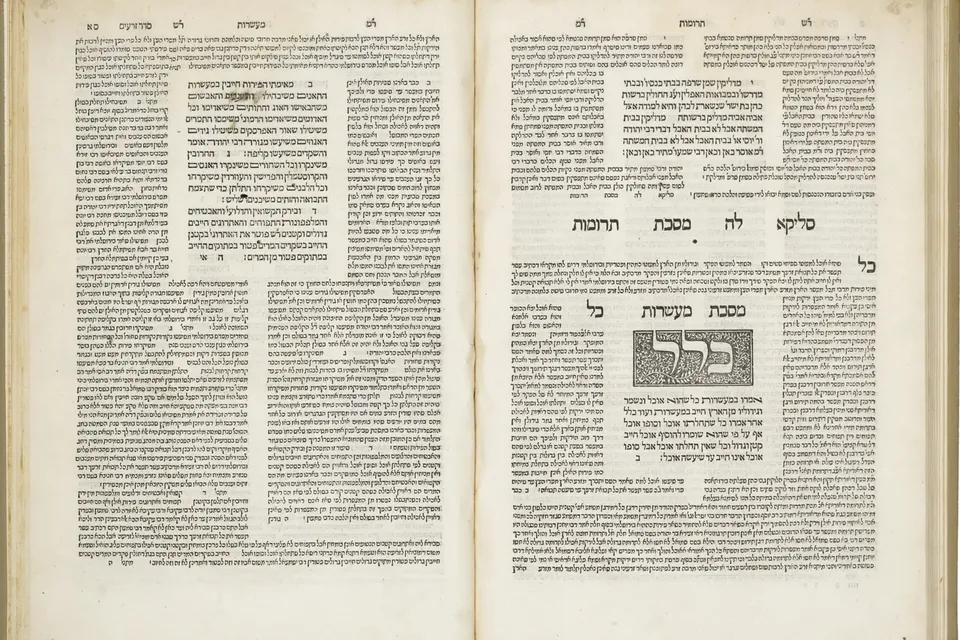
In 1518 Bomberg obtained from the Venetian Senate an exclusive privilege to print the Talmud, with the endorsement of Pope Leo X. Between 1519 and 1523 he produced the first complete edition of the Babylonian Talmud. Its arrangement of each page, with the text of the Mishnah and Gemara in the centre, Rashi's commentary on the inner margin and the Tosafot on the outer margin, and its numbering of folios, became so authoritative that almost every later edition follows it. When a student today cites a passage as "Berakhot 2a", they are, in effect, using Bomberg's page numbers. Over three decades his press issued some two hundred Hebrew books.
Competition, denunciation and fire
Bomberg's success attracted competitors. In the 1540s two Venetian patricians, Marco Antonio Giustiniani and Alvise Bragadin, ran rival Hebrew presses and published competing editions of the same works, including Maimonides' code. Their commercial quarrel turned into an appeal to Rome, and in the process each side, and converts who supported them, denounced the other's books as containing passages offensive to Christianity.
The result went far beyond the two printers. In August 1553 Pope Julius III condemned the Talmud, and on the Jewish New Year of that year copies were burned in Rome's Campo de' Fiori. Venice followed in October 1553, when Hebrew books seized from printers and private owners were burned in Piazza San Marco. Similar burnings took place in other Italian cities. For years afterwards the Talmud could not be printed in Italy, and when the Church later allowed it, it was only in censored form and without its name.
The episode is a reminder that Venice's Hebrew book trade depended entirely on a balance between commercial interest, the Republic's relative independence from Rome and the Church's growing control over print after the Council of Trent.
The censor's pen
After 1553 a system of expurgation developed. Books were examined by censors, often converts, who deleted or inked out words and passages considered hostile to Christianity, replaced terms such as goy or min with neutral ones, and signed and dated the volumes they had checked. Many Hebrew books from Italian libraries still carry these signatures and blackened lines, which historians now use as evidence of who owned a book and when. Jewish editors anticipated censorship by self-censoring their own texts before publication, a practice that has left traces in standard editions to this day.
Venice as a crossroads of languages
Hebrew printing in Venice was not only Hebrew. The presses served communities speaking Italian, Judeo-Spanish and Yiddish, and printed for them prayer books, translations and popular literature in their languages, set in Hebrew characters. The 1609 Haggadah, issued with Judeo-Italian, Judeo-Spanish or Judeo-German translations, is the best-known example (see our article on its images). Yiddish books produced in northern Italy in the sixteenth century, including romances adapted from Italian chivalric tales, are among the earliest printed works of Yiddish literature.
Media: what printing changed
Printing transformed Jewish learning in practical ways. A single standard text of the Talmud or the prayer book could now circulate from Amsterdam to Constantinople, reducing variation between manuscripts but also fixing errors and censored readings for centuries. Correctors such as the rabbis and scholars who worked for Venetian printers became influential intellectuals; Leon Modena, rabbi of the Ghetto in the early seventeenth century, earned part of his living correcting and prefacing books. Title pages, colophons and printers' marks created a new visual culture of the Hebrew book, which artists still quote.
Metaphors: the people of the book
The book is also one of the oldest metaphors of Jewish identity. The Qur'an calls Jews and Christians "people of the Book"; Jewish writers adopted the phrase to describe a culture organised around study and commentary. In the nineteenth century the poet Heinrich Heine famously called the Bible the Jews' "portable fatherland", a homeland that could be carried into exile. Modern Hebrew and Yiddish writers returned again and again to the image of the book as a house, a body or a refuge, and to the burned book as a figure for persecution.
The phrase "histories, media, metaphors" sums up these three ways of looking at the Jewish book. It was used as the title of an international conference on the Jewish book held at Ca' Foscari University of Venice in June 2013, an apt setting for a subject in which Venice played such a large part.
Where to see Venetian Hebrew books
Many early Venetian Hebrew imprints are now in large research libraries, including the British Library, the National Library of Israel and university libraries in Europe and North America, and several have been digitised. In Venice, the Renato Maestro library and archive of the Jewish community and the Jewish Museum hold books and documents connected with the city's printing history.
Sources
- Wikipedia, "Daniel Bomberg" (biography, Mikraot Gedolot, Talmud privilege of 1518, pagination).
- Wikipedia, "History of the Jews in Venice" (Bomberg, Bragadin–Giustiniani dispute).
- Jewish Encyclopedia (1906), "Venice", section on printing.
- Wikipedia, "Censorship of the Talmud" (condemnation and burnings of 1553).
- Wikimedia Commons, Babylonian Talmud, Seder Zera'im, Venice, Daniel Bomberg.

 Books & Haggadah
The New Venice Haggadah project
Eight printmakers, a three-week residency and a famous Haggadah of 1609: the story of a Ghetto-anniversary book.
 Lives & letters
Leon Modena, rabbi of the Ghetto
Sermons that drew Christian audiences, a candid autobiography, and the Historia de' riti hebraici of 1637.
 Ghetto history
The Ghetto, 1516–1797
From the Senate decree of 29 March 1516 to the opening of the gates in July 1797.