Leon Modena (1571–1648): the rabbi who explained the Ghetto to the world
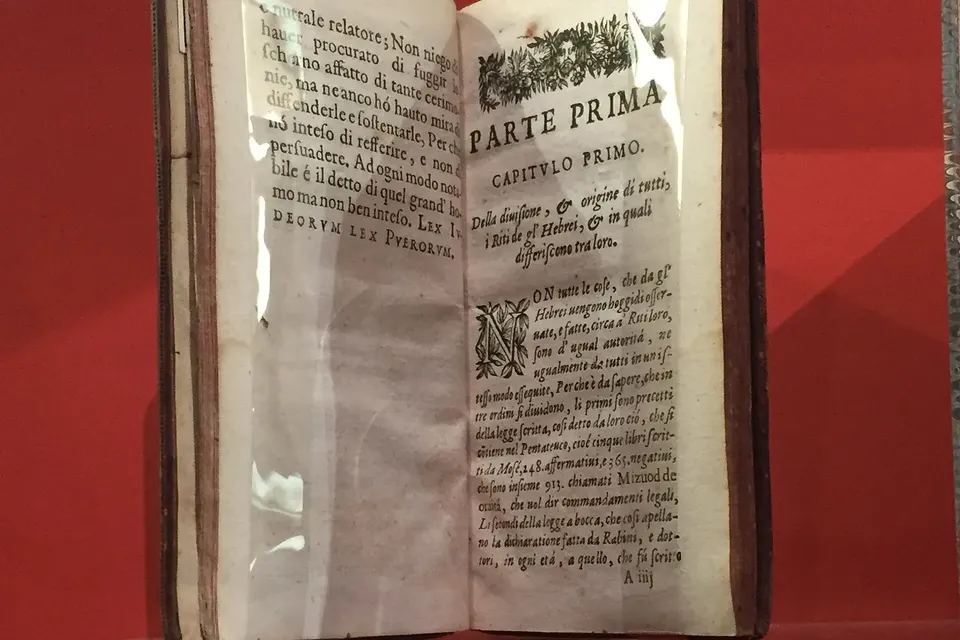
Leon Modena, in Hebrew Yehudah Aryeh mi-Modena, was born in Venice in 1571 and died there in 1648. For four decades he preached, sang and taught in the Ghetto, wrote in Hebrew and Italian, and became, for Christian Europe, the best-known Jewish voice of his time. He also left one of the frankest autobiographies of the early modern period.
Key facts
- Born: 1571, Venice, to a family originally from France that had settled in Italy.
- Roles: preacher, cantor for more than forty years, teacher, corrector of books, member of the rabbinic court.
- Best-known works: Historia de gli riti hebraici (Paris, 1637), the autobiography Hayyei Yehudah, the ethical treatise Tzemach Tzaddik, and polemical works.
- Died: 1648.
A precocious child of the Ghetto
Modena's family had migrated to Italy after the expulsion of the Jews from France in the fourteenth century and had taken its name from the city of Modena. Leon was a gifted child who learned Hebrew, Italian and Latin and started writing early: according to tradition he composed, at around thirteen, a dialogue on the evils of gambling, Sur meRa, which became one of his most reprinted works. The irony did not escape him later in life, since gambling was to be his ruin.
He spent most of his life in Venice, apart from periods in Ferrara and elsewhere, and married young. His family life was marked by tragedy: in his autobiography he mourns children lost to illness and violence, including a son who died after experimenting with alchemy and another killed in a brawl.
Making a living with words
Like many scholars in the Ghetto, Modena never had a single salaried post that sufficed. He listed, with some bitterness, the many occupations by which he earned his living: preacher, cantor, teacher of boys and adults, writer of letters and sermons for others, composer of poems for weddings and epitaphs for tombstones, proofreader and corrector for Hebrew printers, translator, and even maker of amulets. His sermons were his most celebrated activity. He preached in Italian, and visitors to the Ghetto's synagogues included Christian nobles, clergy and foreign visitors who came to hear him.
He was also a cantor for more than forty years and took an interest in music. He was a friend of the composer Salamone Rossi of Mantua, and he wrote a responsum defending the introduction of polyphonic art music into the synagogue, which was printed in Rossi's collection of Hebrew songs published in Venice in 1623.
The gambler's confession
Modena's autobiography, Hayyei Yehudah ("The Life of Judah"), written over many years, is a remarkable document. He speaks openly about his compulsive gambling at cards and dice, which repeatedly cost him his savings and his reputation, about his debts, his illnesses, his quarrels and his grief. Historians value it both as a personal confession and as a source on daily life, epidemics and economic hardship in the Ghetto. An English translation edited by Mark R. Cohen, with historical notes, was published by Princeton University Press in 1988.
Explaining Judaism to Christians
Modena's most influential book was written for non-Jews. At the request of the English ambassador to Venice, Sir Henry Wotton, who wished to present it to King James I, he wrote a description of Jewish rites and customs in Italian. Published in Paris in 1637 as Historia de gli riti hebraici, it described Jewish prayer, festivals, life-cycle ceremonies and beliefs in clear, sober language, avoiding the polemics that dominated Christian writing on Jews. It was translated into English, French, Latin, Dutch and other languages and remained, for more than a century, the standard introduction to Judaism for European readers.
He also taught Hebrew to Christian scholars; among his students was the English chaplain William Bedell, who introduced him in turn to Christian biblical scholarship. These contacts made Modena a sort of cultural intermediary between the Ghetto and the Republic of Letters.
Polemics and doubts
Modena's thought had sharp edges. In Magen va-Herev ("Shield and Sword") he argued against Christian dogmas. In Ari Nohem ("The Roaring Lion"), first printed only in 1840, he attacked Kabbalah and argued that the Zohar was a medieval composition rather than an ancient one, a view later accepted by scholars. A radical critique of rabbinic tradition, Kol Sakhal, was attributed to him by some nineteenth-century scholars, but this attribution has been rejected.
His ethical treatise Tzemach Tzaddik adapted a popular Italian moral handbook, the Fiore di virtù, for Jewish readers, another example of his habit of moving between the two cultures.
Modena and the Venetian circle
Modena moved in the literary world of early seventeenth-century Venice. He was connected with the poet Sara Copio Sullam, whose salon in the Ghetto received Christian and Jewish writers, and he wrote dedications and poems in Italian. His career shows how porous the Ghetto's walls could be in matters of learning, even as residence and trade remained strictly controlled.
A voice in his own words
Part of Modena's appeal for modern readers is that he speaks directly. His letters, many of them preserved in collections compiled by himself, show him asking patrons for money, recommending students, consoling the bereaved and arguing with colleagues. His sermons, of which he published a selection, mix biblical exegesis with allusions to Italian literature and current events. Together with the autobiography, these texts let us hear an individual in the Ghetto with unusual precision, his pride, his anxieties and his humour, rather than seeing him only through official records.
Legacy
Modena died in 1648 and was buried in the Jewish cemetery on the Lido (see the old cemetery). For later readers he has embodied the contradictions of the Ghetto: a rabbi who doubted, a moralist who gambled, a defender of tradition who explained it to its critics. His works remain essential reading for anyone interested in the Ghetto's history and in the Venetian Hebrew book.
Sources
- Wikipedia, "Leon of Modena" (life, works, gambling, Wotton, Bedell, Rossi).
- Mark R. Cohen (ed. and trans.), The Autobiography of a Seventeenth-Century Venetian Rabbi: Leon Modena's Life of Judah, Princeton University Press, 1988.
- Jewish Encyclopedia (1906), "Modena, Leon (Judah Aryeh) b. Isaac".
- Wikimedia Commons, Historia degli riti hebraici, Paris 1637.

 Books & Haggadah
The Jewish book: histories, media, metaphors
Bomberg's Talmud, the bonfire of 1553, the censors' pens and the idea of the book as a portable homeland.
 Places & institutions
The five synagogues
Hidden behind ordinary facades: the German, Canton, Italian, Levantine and Spanish scole.
 Ghetto history
The Ghetto, 1516–1797
From the Senate decree of 29 March 1516 to the opening of the gates in July 1797.